
Sustainability works best when people feel included, not judged. Getting a team genuinely on board does not start with a new policy or a corporate memo. It starts with something simpler: helping people see where they already fit. This guide shows how leaders can make sustainability practical, clear, and meaningful for every level of the team.
How to Get Your Team Excited About Sustainability Without Adding More Work
How to get your team excited about sustainability starts with one honest admission: most teams are already busy, and pretending otherwise does not help. Adding one more initiative to a packed schedule without explaining why it matters, or what it looks like in practice, is exactly how good intentions get ignored.
Dr. Aurora Dawn Benton, founder of Astrapto, has spent more than two decades working with hospitality and events teams on this specific challenge. Her approach has always been the same: don’t make sustainability sound impressive. Make it feel close. When people can see their daily work inside a sustainability goal, their shift, their role, and their small daily decisions, the conversation changes. It stops being about what the company wants and starts being about what individuals can actually do.
Why Teams Tune Out Sustainability at Work
Many sustainability programs fail before they start because people feel left out. The language feels too formal. The goals feel too far away. The tasks feel like one more thing added to an already packed day.
Most teams are already busy, and pretending otherwise does not help. If sustainability feels like another demand with no time, no support, and no clear reason, people will tune out.
That does not mean employees do not care. It means the message has not reached them in a way that feels useful.
| Common Barrier | What Employees May Think | Better Approach |
| Too much jargon | “This is not for me.” | Use plain language and real examples. |
| No clear role | “Someone else handles this.” | Show how each job connects to impact. |
| Too much pressure | “I do not want to get it wrong.” | Focus on progress, not perfection. |
| No time | “This is extra work.” | Build sustainability into daily routines. |
| No visible result | “Does this even matter?” | Share updates, wins, and next steps. |
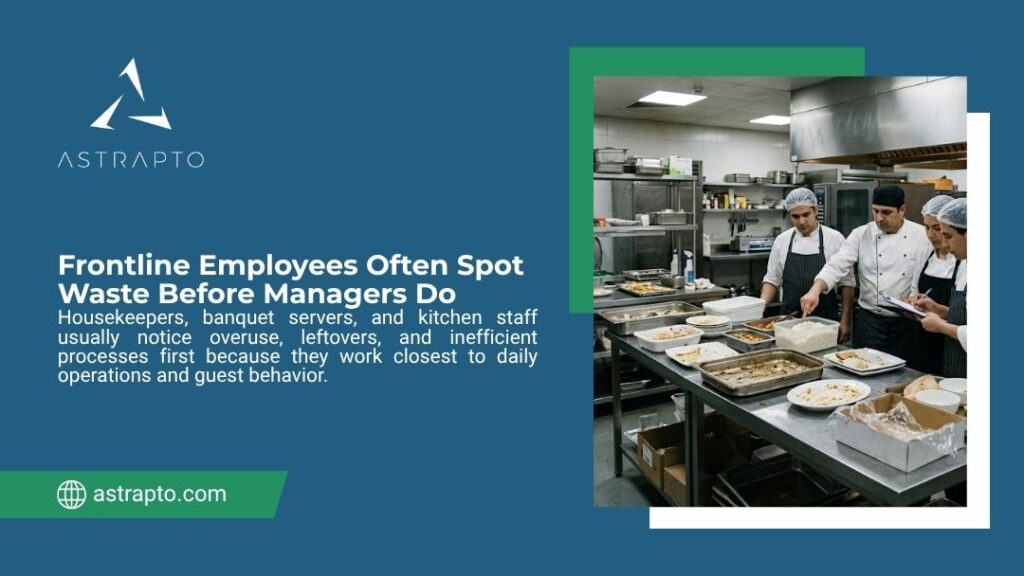
The people closest to the work are often the first to notice the best opportunities. A banquet server sees which dishes come back barely touched every weekend. A housekeeper knows which products run out fast and which sit unused. A front desk agent fields guest questions about the hotel’s green practices more often than most managers realize.
That is why employee sustainability has to include frontline voices, not just plans made at the leadership level.
Start With Purpose, Not Pressure
Sustainability is not only about energy reports, waste targets, or certification milestones. Those things matter, but they are rarely what move people. What moves people is purpose.
Most employees want to feel that their time at work means something. Not in a vague, inspirational way, in a practical, concrete way. They want to know that the shift they showed up for contributed to something beyond the day’s revenue.
Deloitte’s Global Human Capital Trends found that around seven in ten workers said stronger human sustainability commitments would improve their engagement, job satisfaction, productivity, and trust in leadership. That is not a small number.
For leaders, it means the business case for sustainability is also a people case. Talking only about targets misses the part of the conversation that actually builds momentum.
Aurora Benton on this: “When I work with hospitality teams, the first thing I do is separate sustainability from the idea of sacrifice. Sustainability is not about doing less. It is about doing what you already do in a way that leaves things better than you found them. Once people hear it that way, the resistance drops.”
A message that works sounds like this: “Your ideas can help us waste less, serve better, and support the community around us.”
A message that does not work sounds like this: “Corporate needs everyone to follow the new sustainability policy.” One of those starts a conversation. The other ends it.
Make Sustainability Practical for Daily Work
The question of how to get your team excited about sustainability becomes much easier when the answer connects to tasks people already do every day.
A hotel kitchen team does not need a climate science briefing before it can reduce food waste. A banquet team does not need to read an ESG report before it can build a smarter post-event food donation plan. An office team does not need a consultant before it can rethink supply purchasing. What each of these teams needs is a clear, specific starting point that fits the work in front of them.
| Workplace / Role | Practical Sustainability Starting Point | Why This Works |
| Hotel breakfast buffet | Track which items are overproduced each week and adjust prep quantities | Teams can see the impact quickly and feel in control of the change |
| Convention center event setup | Reuse signage across events, sort post-event materials, and coordinate donation pickups | Reduces visible waste and gives setup crews a sustainability role |
| Housekeeping | Review which products deplete fastest, introduce refill systems, and reduce overuse | Connects a daily supply habit to waste reduction without adding time |
| Banquet and catering service | Log leftover food by menu item after each event and flag patterns monthly | Gives teams data they can actually use to influence future menus |
| Front desk / Guest services | Train staff to explain the hotel’s sustainability options to guests in plain language | Builds confidence and positions the property as genuinely committed |
| Event planning | Build a low-waste event checklist covering signage, food, transport, and printed materials | Gives planners a clear framework before decisions get locked in |
| Purchasing / Operations | Audit one product category per quarter for lower-waste or responsibly sourced alternatives | Keeps the work manageable and produces measurable results |
For hospitality and events, food is often the most visible place to start. The U.S. EPA’s Wasted Food Scale puts source reduction, preventing waste before it happens, at the top of its hierarchy because it avoids the problem entirely rather than managing it after the fact. For kitchen and banquet teams, that means better prep planning, not just better composting.
Build a Green Team Without Making It Extra Work
A green team can strengthen a company’s sustainability efforts, but only when it is built with real intention. Too often, leadership asks employees to volunteer for a green team, gives them no time, no budget, no authority, and no clear goal, and then wonders why nothing changes.
A green team that works feels useful, not like a committee that meets to discuss what other people should do.
The UN Global Compact recommends connecting sustainability targets with individual employee goals so that daily work visibly supports something bigger. That is not a small ask; it requires intention from leadership, but it is exactly what separates teams that sustain momentum from teams that hold one meeting and quietly move on.
A green team that actually works includes people from across the business: managers who can remove barriers, frontline employees who know what happens during a real shift, and operations people who understand what changes are actually feasible. And critically, it has a concrete first project. Not five ideas. One. A convention center might start with a food waste review after large events. A hotel might audit product use in housekeeping. An office might look at paper, packaging, or food service waste in the break room.
Small projects are not small when they give people their first real experience of momentum.
Use Training That Feels Useful, Not Like Homework
Sustainability training for employees should answer one question above everything else: What can I actually do in my role?
Training that does not answer that question does not stick. People sit through it, nod, and return to their regular workflow unchanged. That is not their failure. It is a design failure.
A kitchen team needs something different from a sales team, which needs something different from a senior leadership group. A chef working in banquet service wants to understand food waste and prep routines. A sales manager fielding questions from event clients wants language that is honest and practical, not corporate.
A leadership team working on a company’s sustainability strategy wants to understand how to connect goals to daily business processes and how to track progress without creating more administrative burden.
Astrapto’s training approach is built around that reality. The sustainability workshops for teams are designed for groups that need shared language and aligned habits. The online sustainability courses are built for individuals who want structure and practical application. And for organizations navigating larger sustainability goals, Astrapto’s consulting services can help turn intention into a clear roadmap.
Good training does not shame people for what they did not know. It gives them confidence about what they can do next.
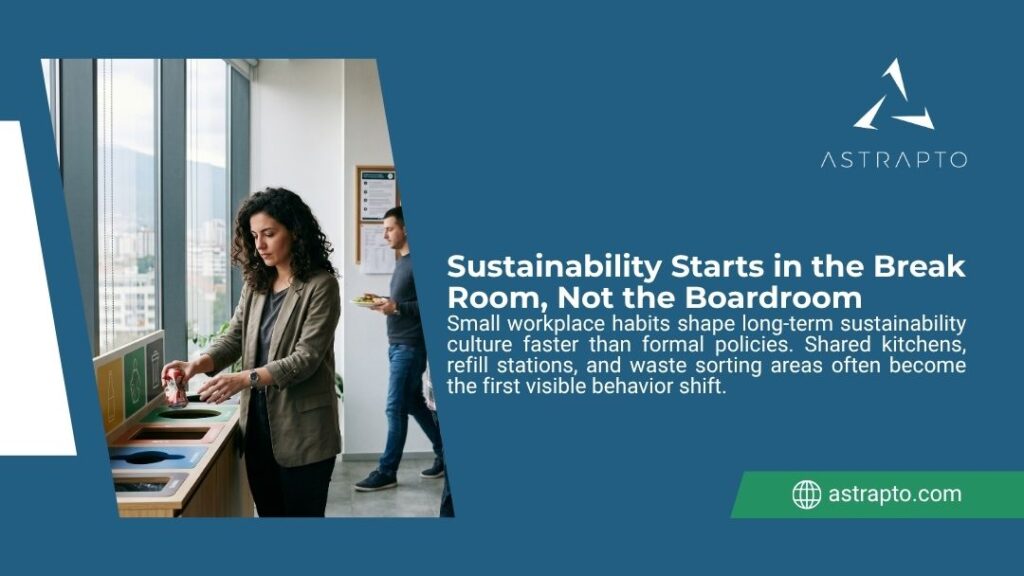
Give Employees Sustainability Project Ideas They Can Actually Use
Not every sustainability project needs to be large. Smaller projects often work better at the start because people can see progress quickly, and early wins build the confidence to try something bigger.
The key is to match the project to the team, not to what sounds impressive in a presentation. A hospitality team and an office team face very different daily realities, and the sustainability work should reflect that.
| Team Type | Sustainability Project Idea | Best Fit |
| Hotel team | Food waste tracking for one week | Kitchens, banquets, breakfast teams |
| Event team | Low-waste event checklist | Planners, venues, and convention centers |
| Office team | Sustainable purchasing swap | Admin, operations, HR |
| Facilities team | Energy and water walk-through | Maintenance and building teams |
| HR or training team | Monthly sustainability moment | Staff meetings and onboarding |
| Leadership team | One sustainability goal tied to the workflow | Managers and executives |
ENERGY STAR notes that commercial buildings can typically cut energy costs by up to 30 percent through structured efficiency improvements, making energy a practical focus for facilities and operations teams. But energy is only one path. Some groups get more traction through food, purchasing, volunteer work, or community impact. The best project is the one people actually understand well enough to repeat.
Share Updates So People See Progress
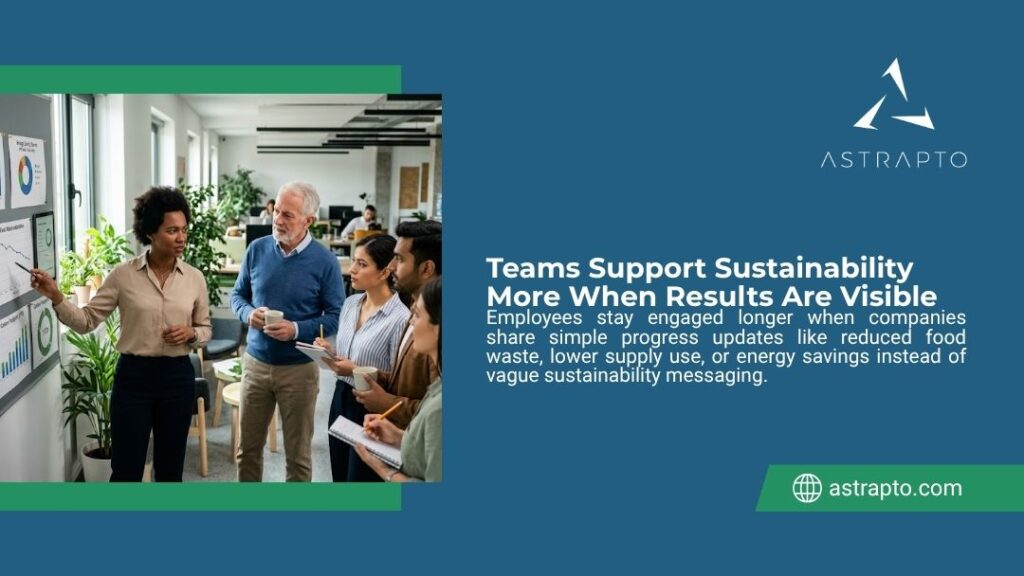
Excitement about sustainability does not hold itself up. It needs to be fed information, specifically evidence that what people did actually made a difference.
A simple update does more than a long report. It tells a person that their idea mattered. It makes a team feel proud of something concrete. And it keeps a program from quietly disappearing after the first month.
A manager might say something like this: “Last month, our banquet team tried tracking food by menu item after each event. We found three dishes that consistently came back with leftovers. We adjusted the prep quantities for this month’s bookings, and we’re already seeing less going into the waste bins. We’ll share the numbers at the next team meeting.” That update is specific, plain, and real. It gives people a story they can repeat and a result they can point to.
Deloitte has also reported that employees have a growing influence on company sustainability plans, with many C-suite leaders acknowledging that their teams already shape, or soon will shape, broader climate commitments. Read more in the Deloitte Global Human Capital Trends report.
Employees are not just the audience for sustainability programs. They are the authors of the best parts.
Celebrate Sustainability Wins Without Making It Corny
Recognition matters, but it has to feel sincere. A pizza party framed around “saving the planet” can go wrong. A public thank-you for a real idea lands better. A quick story in a staff meeting about how a team reduced waste and what they learned that lands best of all.
The goal is to celebrate effort and honest results, not perfection. If a housekeeper noticed a supply issue and raised it, name that. If a banquet team cuts waste in a meaningful way, share the number. If a purchasing manager found a better product option, explain the impact in plain terms.
Success stories do two things: they show the team what good sustainability looks like in practice, and they permit other people to think, ‘I could try that too.’ That second effect is underrated. It is often how a sustainability culture actually spreads — not through a mandate, but through someone saying, ‘We tried this, and here’s what happened.’
Avoid the Biggest Mistake: Making Sustainability Feel Elitist
This is where many organizations get stuck. Sustainability starts to feel like something that belongs to a small group, a sustainability manager, a corporate committee, a senior team with a certificate on the wall.
The language gets technical. The meetings start to feel disconnected from what happens on the floor. And the people closest to the daily work, the ones who could actually change the most, stop feeling like they are part of it.
This is one of the things Astrapto is most deliberate about. Aurora has worked with hospitality, event, and destination teams across hotels, venues, convention centers, and food service environments. The pattern is often the same: when line-level employees feel excluded, the program stalls. When they feel invited in, it moves.
When they feel invited into it, it moves. The goal of every Astrapto workshop and training is to make sure that a housekeeper, a banquet server, a front desk agent, or a sous chef can walk out knowing exactly how their role connects to positive impact. Not in a vague way. In a concrete, job-specific way.
A person does not need an ESG title to reduce waste. They do not need a sustainability degree to notice a broken process. And they do not need to be a senior leader to care deeply about the community their workplace touches every day.
What Are Examples of Sustainability in the Workplace?
Examples of sustainability in the workplace include food waste reduction, energy conservation, green purchasing, reusable event materials, improved recycling systems, local sourcing, water reduction, employee volunteer programs, and sustainability training for frontline teams.
None of those requires a large program to begin. A hotel can start with one week of food waste data from the breakfast buffet. A convention center can start by reviewing what happens to materials after setup is broken down. An office can start with one supply category and ask whether there is a lower-waste alternative.
The best example of sustainability in the workplace is one that people can explain to a colleague in one sentence. If it takes a slide deck to describe it, it probably needs to get simpler first.
A Simple 30-Day Plan to Improve Sustainability at Work
A 30-day plan gives people somewhere to start. It also keeps the work from feeling too open-ended, which is often what causes a good idea to stall.
| Week | Focus | What to Do |
| Week 1 | Listen and observe | Ask employees where they notice waste, friction, or missed chances. Two good questions: ‘What do we throw away too often?’ and ‘What process feels wasteful?’ Take notes, don’t judge. |
| Week 2 | Choose one thing | Pick one idea from what you heard. Not five — one. A focused project is far easier to manage and measure than a broad initiative. |
| Week 3 | Run a small test | Try the idea with one team or one part of the operation. A small pilot gives people room to learn without fear of getting it wrong at scale. |
| Week 4 | Share what happened | Talk about what changed, what did not, and what comes next. Share it plainly, even if the result was mixed. |
For teams that want more than a starting point, outside support can make a real difference. Astrapto’s sustainability consulting services include strategy and roadmap development, food and material waste assessments, business process redesign, analysis, and reporting, without burying leadership in another long list of tasks to manage alone.
When to Bring in Outside Help
Some teams can start with internal ideas. Others need a guide. Outside help may be useful when a business needs a sustainability roadmap, food or material waste assessments, training, reporting, conference sessions, or help with team buy-in.
This is especially true when leaders know sustainability matters but do not have the time to build the program alone. A solopreneur, small leadership team, hotel manager, event director, or operations lead may need a clear process, not another long list of tasks.
Astrapto’s role is practical. The company helps teams move from good intentions to real action through sustainability services, keynotes on practical sustainability, and direct ways to contact Astrapto for support.
Build a Sustainable Work Culture People Want to Join
Getting your team excited about sustainability is not a campaign. It is not a launch event or a one-time training session. It is a culture, and cultures build slowly, through repetition, recognition, and respect.
A strong sustainability culture grows when people feel trusted enough to contribute ideas, included enough to see their role in the work, and respected enough to hear honest results when something does not work perfectly.
For leaders who want a deeper look at how purpose, people, and positive impact come together in a workplace setting, Dr. Aurora Dawn Benton’s book Exponential Impact is a strong next step. Available as an eBook, paperback, and audiobook, it walks through the four themes, empathize, enlighten, empower, and encourage, that have shaped Astrapto’s work with hospitality and events organizations for years.
The real answer to how to get your team excited about sustainability is not a formula. It is a commitment to making the work practical, making it human, and making sure every person in the room knows where they fit.
FAQs About Getting Teams Excited About Sustainability
How do I get employees interested in sustainability?
Start with their daily work. Show how their role connects to waste reduction, better purchasing, guest experience, energy use, or community impact. Keep the language simple and share visible progress.
What are easy sustainability activities for work?
Easy sustainability activities include food waste checks, energy walk-throughs, green purchasing swaps, office supply reviews, reusable event material plans, and short sustainability moments during team meetings.
How can managers promote sustainability in business?
Managers can promote sustainability by setting clear goals, giving employees time to take part, funding small projects, removing barriers, and recognizing useful ideas from the team.
What is a good sustainability example for hospitality?
A food waste assessment is a strong example for hospitality because it can help hotels, convention centers, and event teams see where waste happens and where better planning can help.
Why do sustainability programs fail?
Sustainability programs often fail when they feel too technical, too top-down, or too separate from daily work. People need plain language, clear roles, and proof that their ideas matter.