
Sustainability can sound like a big, formal word. It often gets tied to climate reports, company policies, science terms, and expert-only conversations. But here’s the thing: sustainability starts with everyday choices.
This guide explains how to start learning about sustainability clearly and practically. You’ll learn what sustainability means, why it matters, how it shows up at home and work, and how to take your first step without feeling lost.
At Astrapto, the belief is simple: sustainability should be practical, approachable, and open to everyone. Whether you work in a hotel, convention center, event venue, office, school, or community group, you can have a positive impact through the work you already do. For hands-on help, Astrapto offers practical sustainability support for people and teams that want a clearer path.
Who This Guide Is For
Sustainability feels different depending on where you sit in an organization. This guide is written for all of you.
| If You Are… | Start Here |
| A student or curious beginner | Learn the basic terms, then try one small project |
| A hotel or venue employee | Notice food waste, energy use, laundry habits, and guest-facing choices |
| An event planner | Review menus, printed materials, transport, local suppliers, and leftover food |
| A manager or team lead | Pick one daily team process to improve and track the result |
| An executive or decision-maker | Connect sustainability to culture, cost, risk reduction, and long-term reporting |
No matter where you start, the goal is the same: find one thing you can see, understand, and change. The rest builds from there.
How to Start Learning About Sustainability
The best way to start learning about sustainability is to begin with a simple definition, then connect it to real life. Learn the three main areas first: environmental, social, and economic impact. After that, look at daily choices such as food, waste, energy, water, purchases, travel, and work habits.
You do not need to know everything on day one. In fact, trying to learn every term at once is one of the fastest ways to make sustainability feel harder than it actually is. A better first step is to ask one clear question: “How does this choice affect people, the planet, and future resources?”
In hospitality and events, that question usually surfaces through something visible. A pile of food left at the end of a buffet. Signage is used for one afternoon, then thrown away. A supply order that nobody reviewed because ‘that’s how we’ve always done it.’ Once a team starts noticing those patterns, the next step rarely feels abstract anymore. It feels obvious. That’s when sustainability becomes part of how people work, not an add-on someone else manages.
What Is Sustainability in Simple Words?
Sustainability means using resources in a way that supports life now without harming the ability of future generations to meet their needs. That is the simple version.
The U.S. Environmental Protection Agency (EPA) describes it as people and nature existing in “productive harmony” while meeting the social, economic, and other needs of present and future generations.
In daily life, sustainability means asking better questions before acting. Do we need this item? Can we reduce waste here? Can we save energy? Can this choice also support people and communities?
| Term | Simple Meaning | Everyday Example |
| Sustainability | Choices that can last over time without harm | Reduce food waste at an event |
| Sustainable | Able to continue without using too much | Reusable materials instead of single-use items |
| Environmental sustainability | Care for nature, water, air, soil, and climate | Cut landfill waste at a convention center |
| Social sustainability | Care for people and communities | Donate safe surplus food to a local shelter |
| Economic sustainability | Long-term value that makes financial sense | Save money through smarter purchasing and less waste |
A clear sustainability definition helps because it removes fear from the topic. Once the idea feels simple, acting on it becomes much easier.
Why Is Sustainability Important?
Sustainability is important because every person, business, and community depends on natural resources. Clean water, healthy soil, stable climate, safe food, and strong communities are not side issues. They are the foundation of daily life and long-term business health.
The IPCC’s Sixth Assessment Report documents widespread and rapid changes in the atmosphere, ocean, cryosphere, and biosphere, and notes that near-term decisions can affect climate risks for decades. That may sound large, but the practical meaning is simple: how we use energy, food, water, and materials matters.
Sustainability is also important because waste is not just an environmental issue. It is a people issue and a money issue. UNEP’s Food Waste Index Report 2024 found that the world generated approximately 1.05 billion tonnes of food waste in 2022, with households, food service operations, and retail all contributing.
For hotels, convention centers, and event teams, these numbers are not abstract. Food that goes unsold, materials ordered in excess, suppliers chosen without any sustainability criteria, these decisions affect cost, staff morale, community relationships, and how guests and clients perceive the brand. Sustainability is not separate from the business. It is the business.
The Three Areas of Sustainability You Should Know First
Sustainability is often explained through three connected areas: environmental, social, and economic sustainability. These areas help people see the full picture.
Environmental sustainability looks at the planet. Social sustainability looks at people. Economic sustainability looks at whether a choice can last and make practical sense.
| Area | What It Focuses On | Beginner Question |
| Environmental | Air, water, climate, waste, food, energy, nature | What resources do we use, and what waste do we create? |
| Social | People, health, equity, community, work culture | Who is helped or harmed by this choice? |
| Economic | Cost, long-term value, risk, business health | Can this choice last and still make financial sense? |
A business can recycle and still miss the people side. A company can write a sustainability policy and still fail to change daily habits. That is why sustainability works best when all three areas are part of the same conversation, and why the most effective programs reach everyone from line level to leadership.
Environmental Sustainability Without the Heavy Jargon
Environmental sustainability means taking care of natural systems so they can keep supporting life. It covers climate, water, energy, land, air, soil, biodiversity, and waste.
For beginners, the easiest way to think about environmental sustainability is through visible examples. Food left on buffet trays. Plastic signage used once. Extra printed materials. Lights left on in empty rooms. Water is used without a plan. Deliveries from suppliers with a no-waste policy. None of these examples calls for shame. They call for attention.
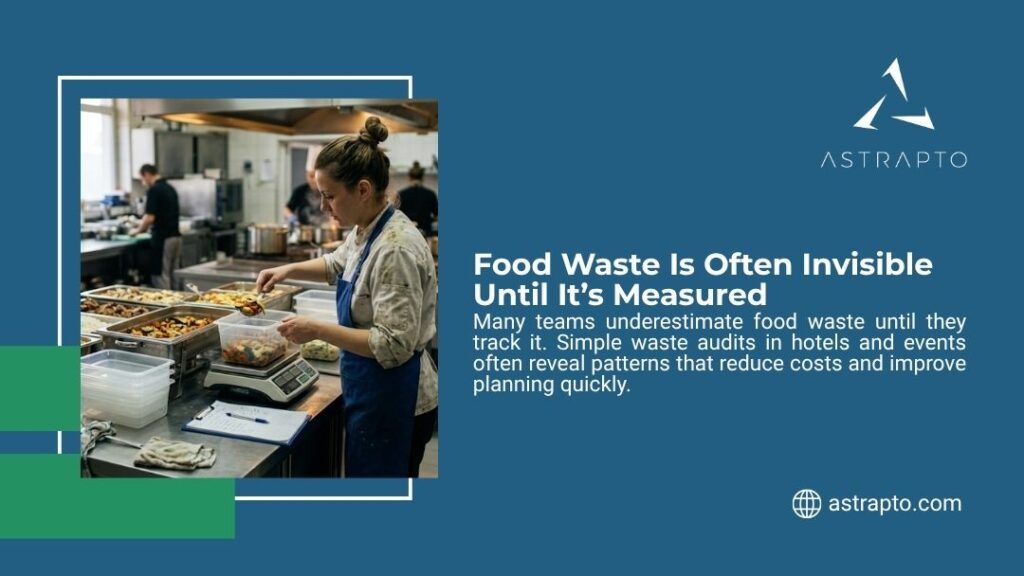
In sustainability workshops with hospitality and events teams, one of the first exercises is simple: map what comes in and what leaves. What enters the building, how much gets used, what gets wasted, and where it ends up. Most teams are surprised by what they find, not because the waste is outrageous, but because no one had ever looked before. That’s not negligence. That’s just how operations run when sustainability isn’t part of the daily conversation. Once it is, things start to shift.
Sustainability Education: What Should a Beginner Learn First?
Sustainability education should help people make better choices, not just memorize terms. UNESCO describes Education for Sustainable Development (ESD) as education that gives learners the knowledge, skills, values, and agency to make informed decisions and take meaningful action for the environment, economy, and society.
That definition matters because sustainability learning is not only about facts. It is also about judgment, values, teamwork, and action.
A beginner should start with the basic terms, then move into real examples. After that, it helps to pick one issue, such as food waste, energy use, purchasing, materials, or community impact. A focused topic gives you something to see, measure, and improve.For people who want structure, Astrapto’s sustainability courses are built for practical learners who want to apply what they learn in real work settings, not just pass a test.
Meet the Guide Behind the Method: Dr. Aurora Dawn Benton
Dr. Aurora Dawn Benton is the founder of Astrapto and the author of Exponential Impact: Harnessing Human Potential to Drive Sustainability in Organizations. With a Doctorate in Business Administration in Social Impact Management and a 35-year career spanning software, retail, financial services, higher education, and consulting, Aurora brings something most sustainability experts don’t: she’s worked on the inside of big organizations and knows exactly why good intentions don’t always reach the front line.
Aurora was named a 2021 Top 30 Sustainability Champion by the International Hospitality Institute. She has helped more than 1,000 professionals globally build sustainable procurement skills, supported 130+ young professionals in launching workplace green teams, and delivered food waste prevention workshops to thousands of hospitality and events professionals.
Her approach, empathize, enlighten, empower, encourage, is the backbone of everything Astrapto teaches. The goal is not to create guilt or overwhelm. It is to build confidence, one practical step at a time.
Her book Exponential Impact is available as an eBook ($8.99), paperback, and audiobook on Amazon. For readers who want a human-centered, jargon-free path into sustainability leadership, it is a strong first read.
A Practical Learning Path for Sustainability Beginners
A clear path can make sustainability feel less scattered. You do not have to read every report or take every course. Start small, then build.
| Stage | What to Learn | Time Required | Best Resource Type |
| Week 1 | Sustainability definition + three areas | 2–3 hrs | Article or short video |
| Week 2 | Waste, energy, water, food, materials | 2–3 hrs | Self-study + field observation |
| Week 3 | People and community impact | 2–3 hrs | Case study or conversation |
| Week 4 | Try one sustainable practice | Ongoing | Hands-on project |
| Month 2 | Work or industry application | 4–6 hrs | Online course or workshop |
| Month 3 | Deeper skills (procurement, reporting) | Varies | Course, consulting, or team project |
This path works because it starts with what you can see. A beginner does not need a perfect sustainability policy. A beginner needs a place to begin.
If you work in hospitality or events, that place might be food waste. If you work in an office, it might be purchasing or energy use. If you work in a school or community, it might be a student-led waste audit or a local sourcing project.
What Are Sustainable Practices?
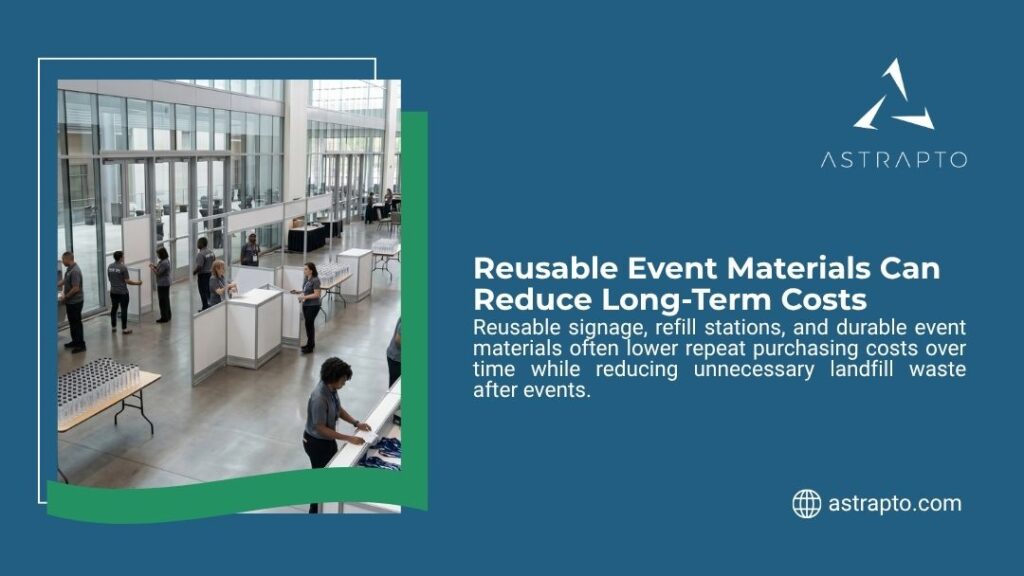
Sustainable practices are habits, policies, and work methods that reduce harm and support long-term value. At home, a sustainable practice may be meal planning to reduce food waste. At work, it may be a better process for ordering supplies. At an event, it may be reusable signage, smarter menus, donation partnerships, or clearly labeled waste stations. The word ‘practice’ matters. Sustainability is not just a belief. It is something people do.
For teams, sustainable practices work best when they are built into the job itself. A server, planner, chef, housekeeper, buyer, manager, or executive should not have to guess how sustainability applies to their role. That is exactly what Astrapto’s team workshops are designed to solve, giving everyone shared language and a clear role in the work.
How Sustainability Shows Up at Work
Sustainability at work is not only about a public promise or a policy page. It shows up in quiet, daily decisions.
It shows up in who orders supplies, how much food gets prepared, what vendors are chosen, how meeting rooms are set, how waste bins are labeled, how staff is trained, and how results get reported up the chain.
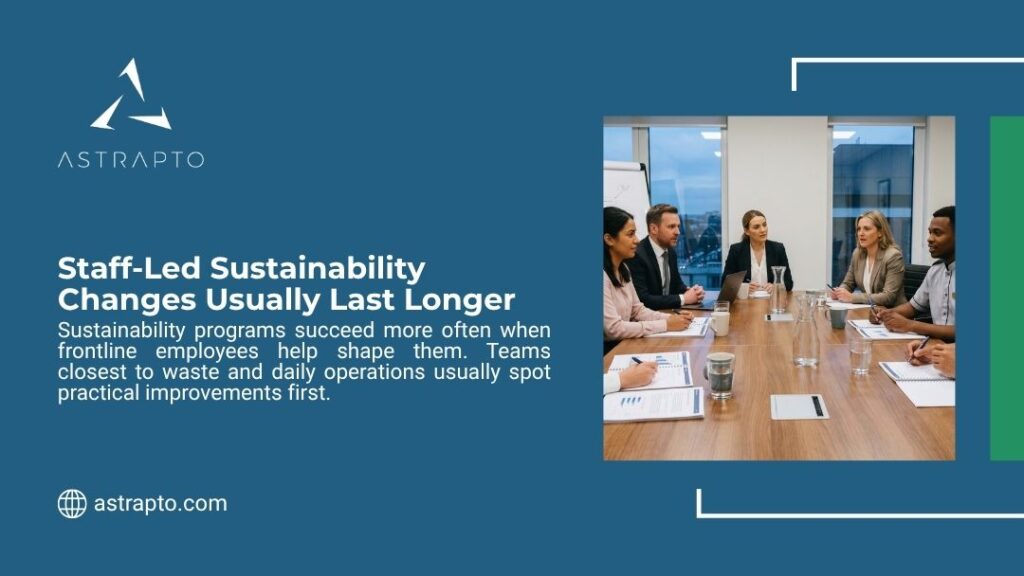
The problem with most sustainability programs is not that they are wrong. It is that they are written for boardrooms and then handed down to people who never had a say in them. Line-level employees, the people closest to the waste, the food, the supplies, and the guests, are often the last ones anyone talks to. Astrapto’s work specifically closes that gap. Workshops and consulting sessions are designed to reach the people who actually make daily decisions, not just the ones who approve annual reports.
How Hotels, Convention Centers, and Event Planners Can Learn Sustainability
Hotels, convention centers, and event planners occupy a unique position in the sustainability landscape. Their work touches food, travel, materials, people, energy, water, waste, and local communities all at once, often at a large scale, often under time pressure.
A hotel might start with laundry optimization, food waste tracking, guest communication, cleaning products, purchasing, and staff-generated ideas.
A convention center might start with post-event waste diversion, vendor qualification, donation systems, utility data, and certification pathways.
An event planner might start with menus, signage, transportation decisions, local supplier lists, printed material reduction, and communication with attendees about sustainable choices.
Sustainability in hospitality is not a checklist problem. Checklists help, but they don’t explain why something matters, who owns it, or what to do when circumstances change. Astrapto’s work in this sector focuses on building understanding alongside process, so that when a food order comes in late, or a supplier changes, or a client makes a last-minute request, the team already knows how to think through the sustainability implications. That kind of readiness doesn’t come from a policy document. It comes from training that actually reaches people.
Courses, Workshops, or Self-Study: Which Path Is Best?
There is no single right path. The best choice depends on your goal, your timeline, and whether you want to learn alone or alongside a team.
| Learning Option | Best For | Watch Out For |
| Self-study | Curious beginners exploring at their own pace | Can feel scattered without a structured plan |
| Online course | People who want a guided, step-by-step structure | Choose one with real-world examples, not just theory |
| Workshop | Teams that need shared language and aligned action | Works best when tied directly to real job examples |
| Keynote/conference session | Fast awareness and motivation | Needs follow-up and reinforcement to create lasting action |
| Consulting support | Organizations with goals but no clear roadmap | Priorities and decision-makers must be clear upfront |
If you are learning for yourself, a course is often the best first step, structured, self-paced, and practical. If your team needs shared language and aligned habits, a workshop is usually more effective than asking everyone to self-study independently. And if your organization already has sustainability goals on paper but no clear path from intention to daily action, that is exactly where consulting tends to make the biggest difference.
Astrapto offers all three. The starting point depends on where you are, not where the industry thinks you should be.
The Biggest Mistake Beginners Make
The biggest mistake beginners make is thinking sustainability has to be perfect. It does not. People often think they need to know every climate term, buy every eco-friendly product, or fix every problem at once. That pressure stops progress before it starts.
Here is something worth remembering: guilt is a poor teacher. People who feel judged for not knowing enough tend to disengage, not improve. The framing that works, the one Aurora has used for decades in workshops and keynotes, is this: you do not have to do everything. You have to do something. Pick one issue. Learn more about it. Try one change. See what happens. Confidence builds from there, and so does the habit.
Food waste. Energy use. Water. Purchasing. Materials. Staff ideas. Community impact. Pick one, start there, and keep going.
How to Tell If a Sustainability Source Is Trustworthy
Not every sustainability source is useful. Some are too vague. Some are too technical. Some make claims without data. Some sell fear or promise perfection.
A trustworthy source explains trade-offs. It uses credible data. It avoids shame. It does not promise instant results. It explains who the advice is meant for and acknowledges that context matters.
Britannica notes that sustainability can apply across environmental, social, economic, cultural, and corporate contexts, a useful reminder that the word means different things depending on the situation. Good sustainability education makes you more thoughtful, not more confused.
For a practical and human-centered entry point, Astrapto’s blog, courses, and book are designed with exactly that standard in mind.
Your First Sustainability Project
A simple first project can teach more than a stack of articles. Choose one waste stream at home, school, or work. Food waste is a strong place to start because it is visible, measurable, and common. Track what gets wasted for one week. Notice where it comes from. Ask why it happens. Then test one small change.
At a hotel, that change might be tightening menu planning. At a convention center, it might be setting up a food donation process. At an event, it might be reducing printed materials. At an office, it might mean smarter ordering or a renegotiated supplier contract.
After the change, look again. Did waste drop? Was the process easy for the staff to follow? Did it save money? Did it benefit the community? That small project can move you from sustainability information to sustainability action.
For a guided next step, you can contact Astrapto for practical support tailored to your organization or industry.
When You Are Ready to Go Deeper
Once you know the basics, more focused topics open up. Sustainable procurement helps you choose suppliers and products with less harm built in. Circular economy thinking helps you move beyond “use and throw away.” Reporting helps you track progress and tell your story credibly. Stakeholder engagement helps you include the people most affected by your decisions.
Food waste assessments, material waste reviews, business process redesign, and sustainability leadership development can all help organizations move from good ideas to real, measurable change.
If your team needs a speaker who can make sustainability feel clear, energizing, and useful to a mixed audience, Astrapto’s keynote sessions are designed for exactly that.
A Better Way to Learn Sustainability
Sustainability should not feel like a closed room where only experts are allowed in. It should feel like a practical skill anyone can build over time. Start with a simple definition. Learn the three main areas. Choose one real issue. Try one useful change. Talk about what worked. Then keep going.
That is how people learn. That is how teams change. That is how sustainability becomes part of work instead of another task on a long list.Astrapto’s work exists for this: to make sustainability practical, approachable, and meaningful for anyone willing to start. Not just executives with strategic plans. Not just sustainability managers with certification goals. Anyone. If you are ready to take a clear first step, explore Astrapto’s sustainability courses today, or reach out to talk about what your team actually needs.
FAQs About How to Start Learning About Sustainability
What is the easiest way to start learning about sustainability?
The easiest way to start is to learn a clear, simple definition first. Then study the three main areas: environmental, social, and economic sustainability. After that, choose one real-life topic, such as food waste, energy, water, purchasing, or materials, and look for it in your own daily environment. A small, visible project builds more confidence than reading alone.
Why is sustainability important?
Sustainability is important because everything depends on it: clean water, safe food, healthy ecosystems, stable energy, and communities that function well. It also matters for businesses because waste, risk, cost, employee purpose, and public trust are all connected to how sustainably an organization operates.
Do I need a degree to learn sustainability?
No. A degree can help if you want a technical career in sustainability, but most people begin with short courses, workshops, books, videos, and hands-on projects. For most beginners, the best first step is to apply core ideas to one real situation, not to earn a credential.
What are examples of sustainable practices at work?
Examples include: reducing food waste through better planning and donation programs, choosing reusable materials over single-use, selecting suppliers based on responsible practices, reducing energy and water use, setting up clearly labeled waste stations, training staff with shared language and practical examples, and tracking results over time. The best practices are simple enough for anyone to use in daily work, not just the sustainability team.